
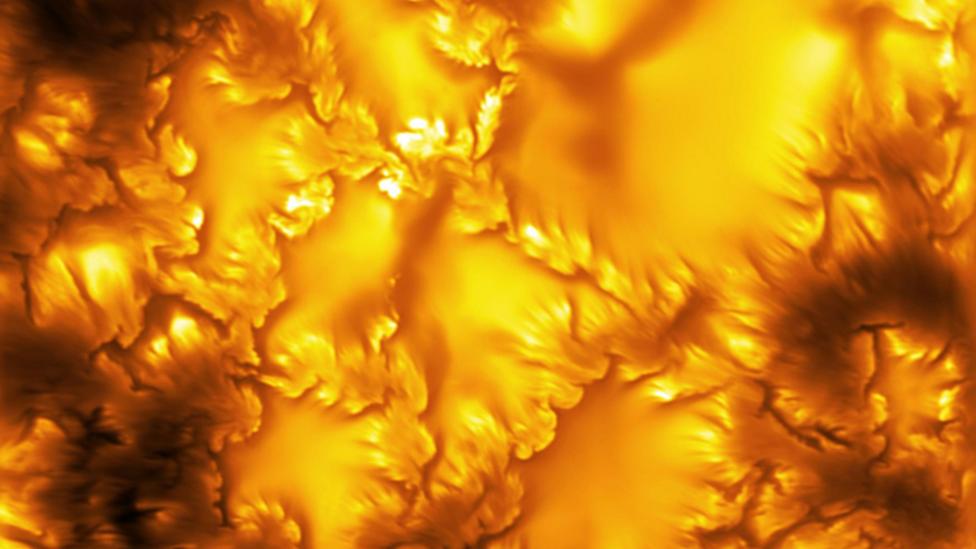
Researchers using the Inouye Solar Telescope have observed previously unseen swirling activity on the Sun's surface, providing new insights into space weather.
Key facts
- •The images were captured by the Inouye Solar Telescope, which is situated on a high peak in Hawaii.
- •The phenomenon discovered on the Sun is called 'Kelvin-Helmholtz instability'.
- •Swirling vortices on the solar surface are caused by the Sun's magnetic field being twisted by hot gas.
- •Solar activity can lead to coronal mass ejections that potentially impact Earth's power grids and satellites.
- •The research findings were published in the journal Nature.
Scientists have captured the most detailed images of the Sun to date using the Inouye Solar Telescope, located on a high peak in Hawaii. The footage reveals previously unseen swirling vortices on the solar surface, which researchers identify as the result of the Sun's magnetic field being moved by hot gas.
Understanding space weather
The observed swirling motions, known as Kelvin-Helmholtz instability, occur when hot gases slide past each other, creating spiraling vortices. Dr. David Kuridze of the National Solar Observatory (NSO) notes that these motions generate magnetic energy that can accumulate and lead to large-scale explosions, such as solar flares or coronal mass ejections. These events create space weather that can disrupt Earth's power grids and satellites and pose risks to astronauts.
Scientific significance
The findings, published in the journal Nature, are intended to help scientists better predict space weather by understanding the physics of the Sun at smaller scales. Dr. Friedrich Woeger of the NSO stated that these observations also help explain the high temperatures found on the Sun's surface. Beyond practical applications, researchers view the Sun as a unique laboratory for studying fundamental laws of physics.
Advertisement
This article was independently rewritten by ManyPress editorial AI from reporting originally published by BBC Science & Environment.