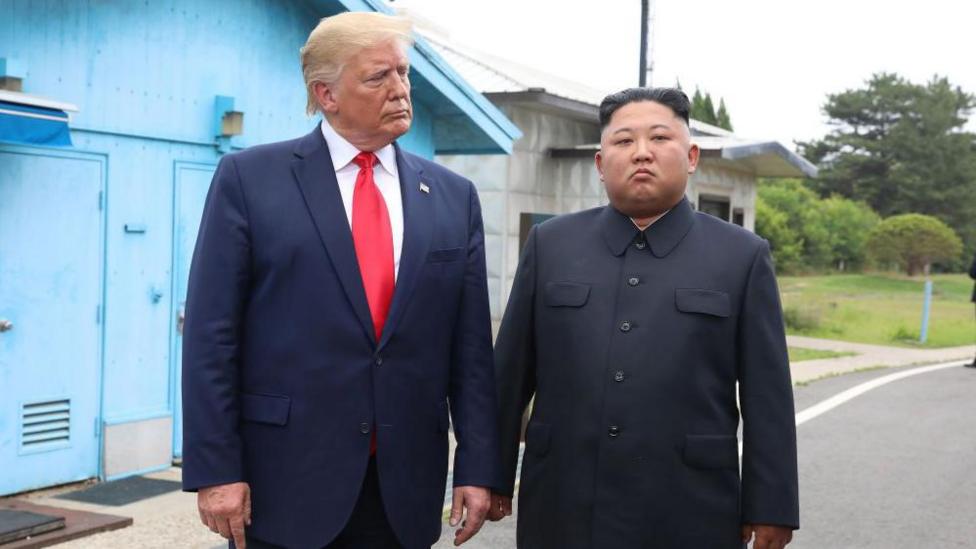
President Donald Trump has directed the Pentagon to scale back joint military drills with South Korea, citing the country's refusal to join US efforts regarding Iran and his relationship with Kim Jong Un.
Key facts
- •President Trump cited his relationship with Kim Jong Un and South Korea's refusal to join US efforts against Iran as reasons for the reduction.
- •The 11-day Ulchi Freedom Shield exercises involve 18,000 South Korean soldiers and began on Monday.
- •South Korean officials confirmed that the military drills will continue as originally scheduled.
- •Approximately 28,500 American military personnel are currently stationed in South Korea.
- •North Korea has recently conducted ballistic missile tests that are banned by the United Nations.
President Donald Trump announced on Sunday that he has instructed Secretary of Defense Pete Hegseth to substantially reduce annual joint military exercises with South Korea. Trump stated the decision was influenced by South Korea's refusal to join the US in the "denuclearisation" of Iran and his positive relationship with North Korean leader Kim Jong Un. While Trump described the exercises as costly and hostile, South Korean officials stated that the drills would proceed as scheduled.
By the numbers
Scope and Context of the Exercises
The 11-day training event, known as Ulchi Freedom Shield, began on Monday and involves approximately 18,000 South Korean soldiers. The exercises are one of two major annual combined drills conducted by the two nations, intended to bolster readiness against threats from North Korea. US military officials previously stated that the training was designed to reinforce the alliance's role in regional security and account for evolving threats, including North Korea's recent deployment of troops to support Russia in the war against Ukraine.
Expert and Official Reactions
The announcement marks a shift from recent months, during which the US administration praised South Korea for its increased defense spending and commitment to regional security. Experts, including Professor Leif-Eric Easley of Ewha University, have cautioned that scaling back these exercises could weaken deterrence, damage alliance coordination, and slow South Korea's progress in taking on greater responsibility for its own defense. They noted that the potential cost savings from downsizing are marginal compared to the strategic risks.
Timeline
- 2019High-stakes diplomacy between Donald Trump and Kim Jong Un collapsed.
- MaySecretary Hegseth praised South Korea's commitment to defense spending and alliance burden-sharing.
- SundayPresident Trump announced his instruction to reduce the joint military exercises.
- MondayThe annual joint military exercises began as scheduled.
Advertisement