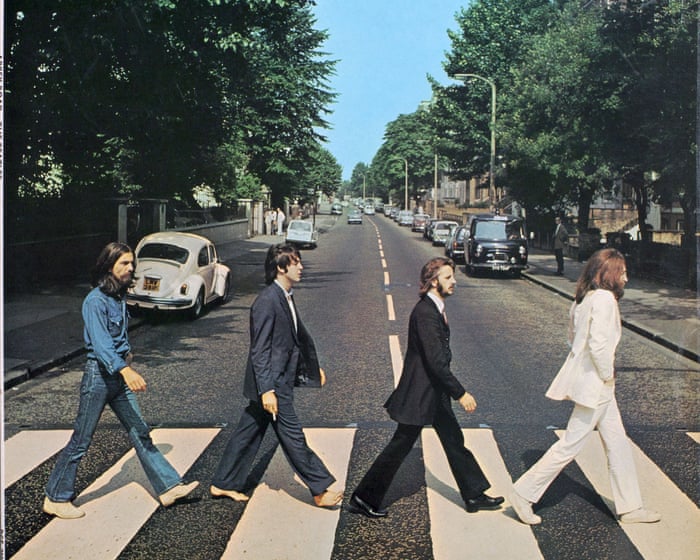
Photographed on August 8, 1969, the Beatles' Abbey Road album cover remains an iconic piece of conceptual art that continues to inspire recreations and parodies.
Key facts
- •Photographer Iain Macmillan took the iconic photograph on August 8, 1969.
- •Paul McCartney suggested the location and provided sketches for the planned composition.
- •The shoot took place outside the Abbey Road music studios in St John’s Wood, London.
- •A police officer was used to stop traffic to allow the band to walk across the zebra crossing.
- •The image has been parodied by various acts, including the Red Hot Chili Peppers, Kanye West, and Booker T and the MGs.
- •Director Sam Mendes recently recreated the scene for his upcoming series of four Beatles biopics.
The Beatles' Abbey Road album cover was captured by photographer Iain Macmillan on August 8, 1969, outside the band's music studios in St John’s Wood, north London. The image features the four band members walking across a zebra crossing, a scene that has since become a globally recognized cultural touchstone. The photograph was a deliberate, planned effort rather than a spontaneous snapshot, reflecting the band's interest in conceptual art during that period.
Conceptual Origins and Execution
The photograph was not a matter of chance, but a carefully orchestrated piece of conceptual art. After the group rejected an initial idea to be photographed in Nepal, Paul McCartney suggested the location outside the Abbey Road studios. McCartney provided sketches for the composition, which included a view from above and the band members depicted as stick figures on the crossing. On the day of the shoot, a police officer was enlisted to halt traffic, and Macmillan captured the image while standing on a stepladder.
Symbolism and Cultural Legacy
The image has invited decades of interpretation, including the "Paul is dead" conspiracy theory, which emerged due to McCartney appearing barefoot in the photo. While some fans interpreted the band members' clothing as symbolic of a funeral procession, the theory was dismissed as the photograph was a creative project led by McCartney himself. The cover's aesthetic, which combines a deadpan foreground with a haunting perspective, has been compared to the work of surrealist painter René Magritte, whose art McCartney began collecting in 1966.
Timeline
- 1966Paul McCartney began collecting paintings by the surrealist artist René Magritte.
- January 1969The Beatles performed live on the roof of Apple Corps in London.
- August 8, 1969Iain Macmillan photographed the Beatles on the Abbey Road zebra crossing.
- September 1969John Lennon told the group he intended to leave the band.
Advertisement
This article was independently rewritten by ManyPress editorial AI from reporting originally published by The Guardian Culture.