
The Rhine, Danube, and Po rivers have reached record low levels, disrupting shipping, energy production, and agriculture across Europe.
Key facts
- •44% of Rhine measuring stations and 78% of Danube stations recorded extremely low water levels at the end of July.
- •The Danube's water levels fell to their lowest in 30 years in countries including Serbia and Romania.
- •Hungary's only nuclear power plant was shut down due to the low water levels on the Danube.
- •Italy raised its drought alert level to 'high' across the entire Po Valley following historic lows near Cremona.
- •Researchers attribute the increased likelihood of drought to human-caused climate change increasing evaporation rates.
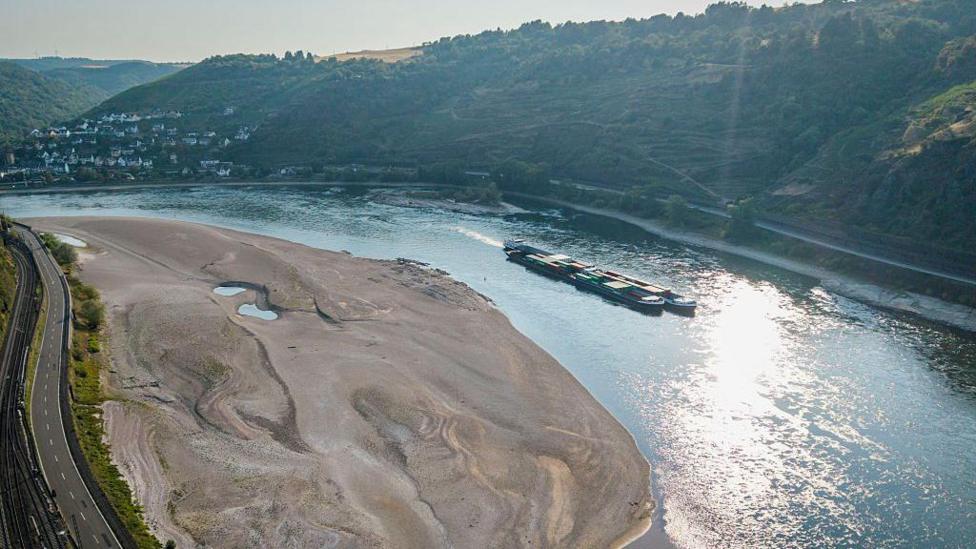
The River Rhine has fallen to record low levels in Germany and the Netherlands, joining other major European waterways like the Danube and the Po in experiencing historic water shortages. Prolonged heatwaves and drought conditions have strained these critical transport and industrial arteries, with temperatures in some regions forecast to exceed 40C. The low water levels are impacting shipping capacity, power generation, and agricultural irrigation across the continent.
By the numbers
Shipping and Economic Impact on the Rhine
The Rhine, a vital European waterway, has seen water levels drop to record lows at gauging stations in Cologne and Lobith. At the Kaub chokepoint, water depth hit a 2018 record low of 25cm on Friday before a slight recovery on Monday. Martin Wolters of the Rhine Waterways and Shipping Authority noted that while total suspension of shipping is unlikely, operators must reduce cargo loads to prevent damage, which risks increasing transport costs and creating supply bottlenecks.
Energy and Agricultural Disruptions
Low water levels on the Danube have forced Hungary to shut down its only nuclear power plant, with Prime Minister Peter Magyar stating the restart date remains unknown. Serbia has reduced output at coal-fired power plants due to cooling system issues, while Romania conducted a controlled explosion on the Danube to improve water flow to the Cernavoda nuclear plant. In Italy, the Po river's record low near Cremona has triggered high drought alerts and allowed saltwater intrusion, threatening local irrigation and drinking water supplies.
Climate Factors
According to the EU's Drought Observatories, drought conditions remain critical across much of Europe, with worsening conditions reported in central-western regions as of mid-July. While a study by the World Weather Attribution group found no clear long-term trend of lower rainfall, researchers concluded that human-caused climate change is increasing evaporation through higher temperatures, thereby raising the likelihood of drought.
Timeline
- Mid-JulyDrought conditions worsened in central-western Europe.
- End of JulyExtremely low water levels were recorded at a majority of Rhine and Danube measuring stations.
- FridayThe water depth at the Kaub chokepoint hit a record low of 25cm.
- MondayWater levels at Kaub recovered slightly, and Hungary's Prime Minister addressed the nuclear plant shutdown.
Advertisement
This article was independently rewritten by ManyPress editorial AI from reporting originally published by BBC Science & Environment.